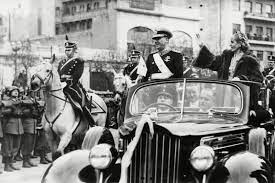
After Leonardi had overthrown Peron, he recognized the efforts and strengths that Peron had achieved. However, in November 1955, Leonardi was displaced out of government by Pedro Aramburu, a military dictator. He made attempts to amend the constitutional government, resisting the anti-Peronist ideology. When he got into power, he dissolved Peron’s party and installed labor unions as state administrators. In 1958, Arturo Frondizi got support from the anti-Peronist. Frondizi got into power and promised to the Peronists to return them to power. Frondizi being in power, focused his attention on economically developing the country. Sooner, the country experienced a surge in inflation which presented the middle and low-class citizens with adverse economic impacts. The rapid radicalization in inflation had to be revived by ensuring that the foreign investors were supported. However, the economic policies proposed by Frondizi got criticized, and he got tasked to use the military personnel to uphold his unpopular policies.
By the year 1962, the Peronists gained tremendous control of several districts in the region. Later in July 1963, the elections were conducted, and Arturo Illia emerged the victor. Illia inherited most of the economic problems that resulted in the Frondizi era. The reorientations that Illia proposed saw Argentina make tremendous economic success. He also tried to separate the Peronists, but it resulted in vain. Presently, the Argentina’s constitution is federal with an independent judiciary. The president is head of the state and the government. The president is responsible for exercising executive powers. Additionally, the bicameral national congress constitutes the chamber and the Senate and is responsible for executing legislative powers (Santella, 2020).
Work Cited
Santella, A. (2020). “The Dynamics of Violence and Labor Conflict in Villa Constitución, Argentina.” 1973–1975 The Capitalist Commodification of Animals: Emerald Publishing Limited.
“Argentina – The Conservative Restoration and the Concordancia, 1930–43.” Encyclopedia Britannica, https://www.britannica.com/place/Argentina. Accessed 9 Apr. 2021.

This work is licensed under a Creative Commons Attribution-NonCommercial-ShareAlike 4.0 International License.