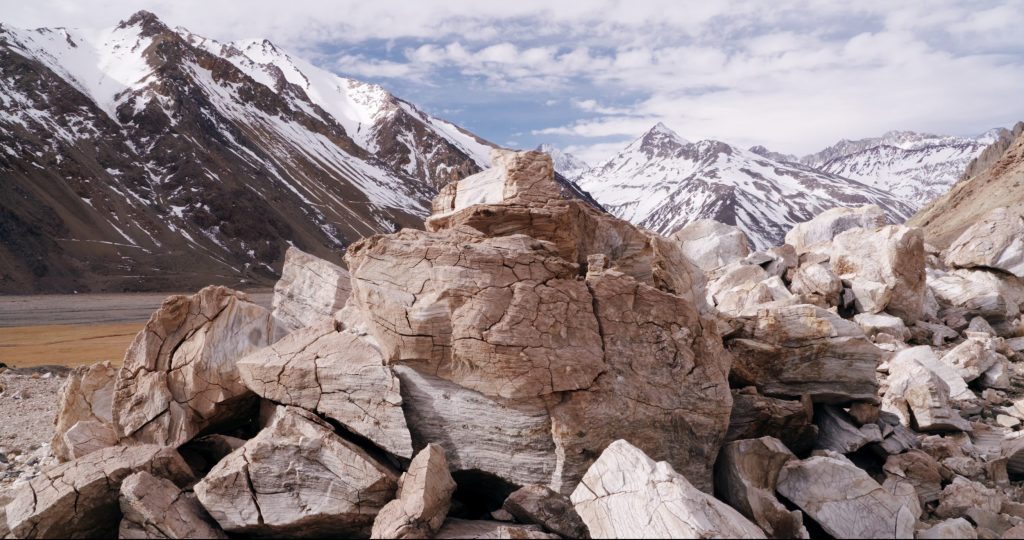
The seventh chapter “The Heart of the Andes” of the travelogue Tropical America written by Ford and Isaac Nelson, published in 1893 is a travel account depicting one of the individual’s trips climbing the Chilean Andes. He seems to be very wary of the Chilean tour guides and demonstrates his distrust towards the local people from the start. However, he seems quite amazed with the nature and the scenic views that the Chilean Andes provide. According to the Biblioteca del Congreso Nacional de Chile (The national congress library of Chile) the civil war in Chile ended in 1891, placing this travelogue at a post-civil war society and nation which would mean that the traveller found the Chilean people at a certain desperation for money (Nacional).
The author’s view of Latin America is a condescending one, specifically directed to the people of Latin America rather than Latin America itself. He talks about the guides with great distrust and expresses a positive view of only one Chilean muleteer which seems to have a “face that inspired confidence.” (Ford and Nelson 127). Little does he describe the face other than the fact that it inspired confidence which makes us wonder: how did the face look like? Considering the Chilean was a muleteer it is safe to assume that he probably wasn’t indigenous, and he was upper middle class due to the fact that climbing mountains as a muleteer was a privilege at the time and not many lower class people would be able to, unless it was through work, such as the guides. Therefore, the face that inspired confidence to our American traveler was one of a mestizo, upper-middle class Chilean, and his distrust seems to come from a certain sense of superiority. His sense of superiority is further emphasized when he mentions an encounter with two Chileans “(…) who did not know a word of English (…)” (Ford and Nelson 127). His necessity to establish whether or not they spoke English whilst being himself the foreigner in Chile states his belief in being the deserving race, the race that deserves to have their language spoken elsewhere accentuating his white superiority. This suddenly changes when he sees the beauty of the Andes, his superiority becomes admiration and he uses only positive adjectives to describe and admire the beauty of a country that is not his, adjectives that he did not once direct towards the local people. The scenery of Latin America, the riches of Latin America, the natural resources of Latin America are praised because they are of use whether it is for their own consumption or for their own pleasure, but the people of Latin America are pushed to the side when they do not serve a purpose or when they do not achieve the Eurocentric standards. Which is a colonizer’s perspective that goes as far back as the day Columbus set foot in America, marveled by the scenery, by the nature, by the riches but disrespecting the people because they were of no use and they didn’t enter in their Eurocentric standards. The author had a typical colonizer’s view of Latin America and its people.
This view that the author carries, reveals that in the 19th century Latin America was still viewed as a store. A store where white people had to pay a minimum price for the services and for the resources and for the experience and for whatever they needed with a complete disregard for the native people. A place to take from. It reveals that the view hadn’t changed much from when America was first discovered by Columbus, even though it had gained its independence, the view from the outside was still one much similar from when it hadn’t. It is even more curious to see that only certain people from Latin America were accepted in their own country and it makes sense because indigenous people have been disregarded ever since the colonization, even though they carry the richest and last pieces of culture from what was originally Latin America.
Sources:
Ford, Isaac Nelson, 1848-1912. Tropical America. New York: Charles Scribner’s Sons, 1893.

This work is licensed under a Creative Commons Attribution-NonCommercial-ShareAlike 4.0 International License.